If you can’t compete on price, what do you compete on?
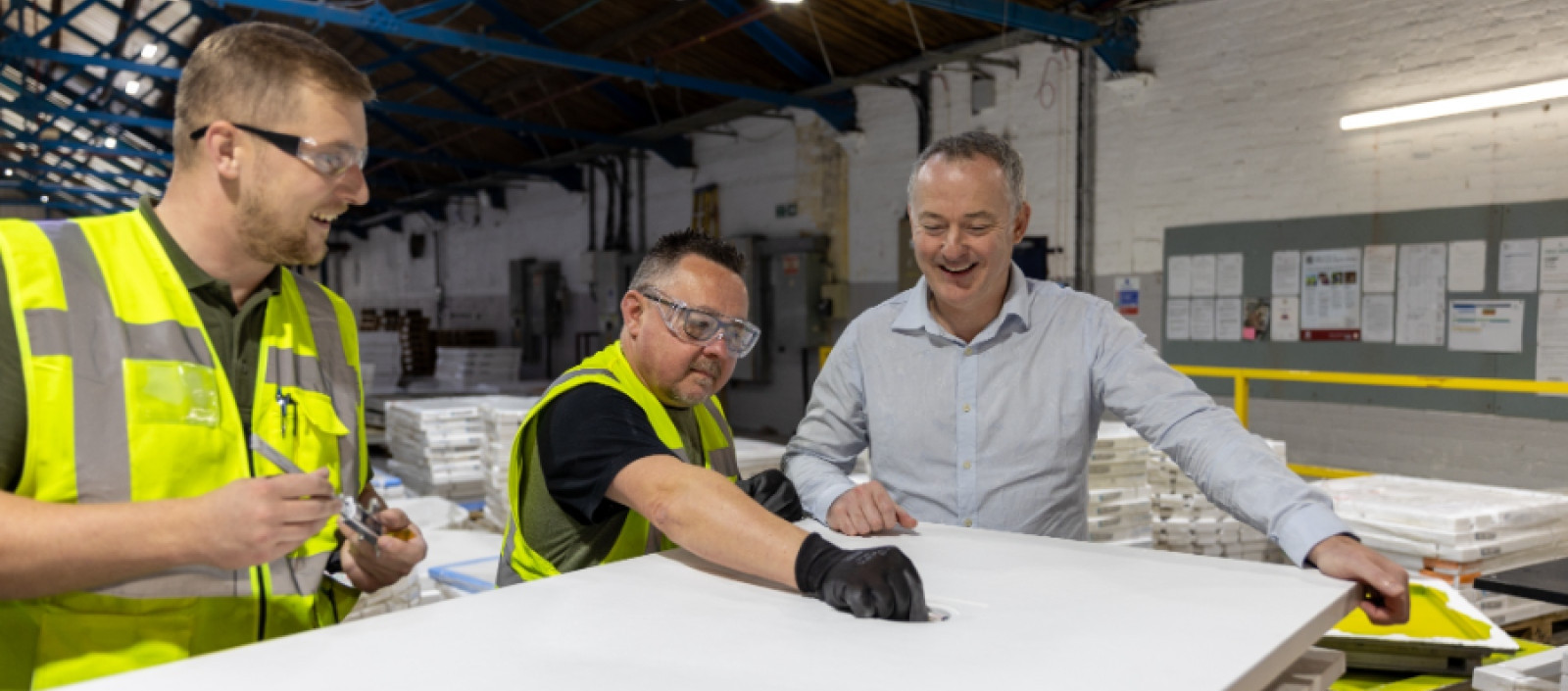
With wage costs up to 20 times higher than some overseas competitors, UK manufacturers can’t compete on price alone. One managing director explains why local supply chains are the strongest commercial response businesses have.
It’s a conversation David Mosley, MD of family-owned bath manufacturer Trojan, has heard many times. Quotes come back with the familiar two words, “too expensive.” For many buyers, a bath is a white, inert object in the corner of a bathroom. It holds water. You pull the plug, it drains. So why pay more? On the surface, it’s a fair question. David sees it differently.
A Trojan bath is made from nine distinct components: acrylic sheet, glass fibre, resin and catalyst, bath grips, chipboard and timber framing, metal and plastic fittings, cardboard packing, pallets and shrink wrap. Each one has its own supply chain, lead time, quality standards and cost. The final price reflects every single one of those decisions.
The numbers don’t lie
Trojan competes against low-cost imports from Turkey and Egypt, where the minimum wage can be less than £100 a month. In the UK, it’s around £2,200, and Trojan pays above the living wage to attract good people. Egypt pays about 3.1p per kilowatt hour for energy, while UK manufacturers are paying an average of 24p.
David’s done the maths. If he moved Trojan’s Huddersfield operation to Egypt, he’d save around £6m a year on wages and energy alone – roughly £21 per bath, based on 250,000 units. “The disparity is quite stark,” he says, and that’s before a sales conversation even starts.
What local sourcing delivers commercially
Trojan’s strategy isn’t to chase a price gap it can never close. Instead, it makes the case for what its price actually represents. David compares it to shopping at a farm shop. “You pay slightly more but you know what you’re getting – quality, provenance and suppliers who are accountable to the same standards you are.”
Local sourcing brings real commercial advantages. Supply chains are shorter and easier to manage. You can easily visit suppliers, audit their operations and check standards in person. When problems crop up, you can resolve them directly and quickly, without language barriers or 12-hour time differences.
The materials Trojan uses reflect that thinking: timber from Scotland, cardboard from Derbyshire, resin from Essex, fittings from South Yorkshire and bath grips from the Midlands. Not everything is British, David admits. Acrylic – a primary raw material – switched to an Asian supplier four years ago when UK costs became “prohibitive”. It went against Trojan’s “moral grain,” but the business still needs to compete commercially, and they were upfront with customers and suppliers about the decision, says David.
But that decision came with hidden costs. To make overseas acrylic work, Trojan now holds 60,000 blanks in a third-party warehouse. That ties up working capital, commits warehouse space and adds supply chain complexity. Compared to a local supplier delivering in two weeks, those extra costs don’t show up in a simple price comparison.
The complexity is offset, in part, by the strength of Trojan’s relationships. David believes Trojan ranks among the top three customers for many of its suppliers, built on honesty and prompt payment, with 90% on 30-day end-of-month terms. That position pays dividends. During Covid, and again during the recent Middle East conflict, suppliers gave Trojan early warning of price increases and offered protection where they could. You can’t put that on a spreadsheet, but it matters.
The real cost of cheap
David shared a story to show the hidden cost of buying cheap. A long-standing Trojan customer ordered two containers from an Eastern European supplier. The price was lower and the product arrived on time. That’s where “the good news ended.”
Wrong specification. Fittings not included – they arrived on a separate invoice. Baths palletised horizontally rather than upright, so the customer had to buy new pallets and redeploy staff to decant and re-rack everything. The invoice price wasn’t the total cost. Not even close.
The problem, David argues, is how procurement decisions get made and measured. “As a nation, we’re encouraged to support local shops, local restaurants, local coffee shops and local businesses. There’s no reason that logic shouldn’t apply to commercial procurement.”
The hidden costs of buying cheap don’t appear on invoices. They show up later – in rework, delays, missing components and the staff time needed to sort it all out. Quality, transparency and supply chain accountability have commercial value. For the right customers, they’re reasons enough to pay more. It’s a case Trojan has made consistently for over 50 years, and one the market is still learning to value.
Join our Next Industry Meet-up!
The opportunity to openly discuss challenges, opportunities and solutions is what makes the Made in Group’s Industry Meetups so invaluable.
During these captivating virtual events, industry experts, thought leaders, and professionals gather to share knowledge, insights and best practices.
The goal is to foster collaboration, inspire innovation, and drive growth within the manufacturing community.
Each meet-up, we feature three engaging talks from Made Members, focusing on best practices around key themes that shape the future of manufacturing, including Global Trade, People & Skills, Future Factories, and Sustainability.
Presentations are followed by interactive Discussion Groups. These virtual roundtables enable Members to exchange ideas and gain further insights on their chosen topic.
We look forward to seeing you at the next one: